
The Black Village Beneath Central Park: The Story of Seneca Village

Updated: May 4
Every year, more than 40 million people walk through Central Park.
They jog along its paths. They rest on its benches. They spread blankets across its lawns and watch their children play beneath trees that have stood for more than a century. Central Park is one of the most famous public spaces in the world—a symbol of beauty, leisure, and New York City itself. But almost none of those visitors know what lies beneath it.

Before the footpaths were laid, before the trees were planted, before the lawns were shaped and the fountains were built, there was a neighborhood here.
A real neighborhood.
With homes. Churches. A school. Cemeteries. Families. Children. Property owners. Voters. Dreams.
It was called Seneca Village.
And the people who built it were free Black Americans who had done something extraordinary in a country designed to keep them from doing it.
They bought land.
They owned it.
And they built, on that land, one of the most remarkable Black communities in the history of New York City.
Seneca Village stood in what is now Central Park, roughly between West 82nd and West 89th Streets. Established in 1825, it grew into a community of mostly Black property owners, along with Irish and German immigrants, before it was destroyed in 1857 to make way for Central Park.
This is the story of what they built.
And what the city took.
Black Freedom in the So-Called Free North
To understand Seneca Village, we have to understand New York in the early 19th century.
New York was not the innocent “free North” that many people imagine. The state did not fully abolish slavery until 1827, and even after abolition, free Black New Yorkers faced deep, systemic racism in nearly every part of public life.
They could technically own property, but finding someone willing to sell land to them was difficult. They could technically work, but they were often confined to low-paying, unstable, and dangerous jobs. They could technically live as free citizens, but freedom did not mean equality, safety, or dignity.
Housing was one of the most urgent problems.
Black New Yorkers were often pushed into overcrowded neighborhoods in lower Manhattan, where housing was expensive, inadequate, and neglected. Many lived in damp basements, cramped rooms, and deteriorating buildings. Landlords charged Black tenants high rents for poor conditions, knowing discrimination left them with few alternatives.
Then, white society pointed to those conditions as evidence of Black inferiority.
It was a vicious cycle: deny people resources, then blame them for the consequences of that denial. But Black New Yorkers were not passive in the face of this injustice. They organized. They built institutions. They created mutual aid societies, churches, schools, and communities.
And they understood something profound: Land meant power.
If you owned land, you had stability. You could not be evicted at a landlord’s whim. You had something to pass down to your children. You had a foundation.
And in New York at the time, land also meant political power.
Under New York’s 1821 state constitution, Black men had to own at least $250 worth of property in order to vote. White men had no such property requirement. This law was designed to suppress Black political participation while maintaining the appearance of legality.
For most Black New Yorkers, that requirement was nearly impossible to meet.
But some did. And Seneca Village became one of the places where Black land ownership translated into Black political voice.
The First Lots
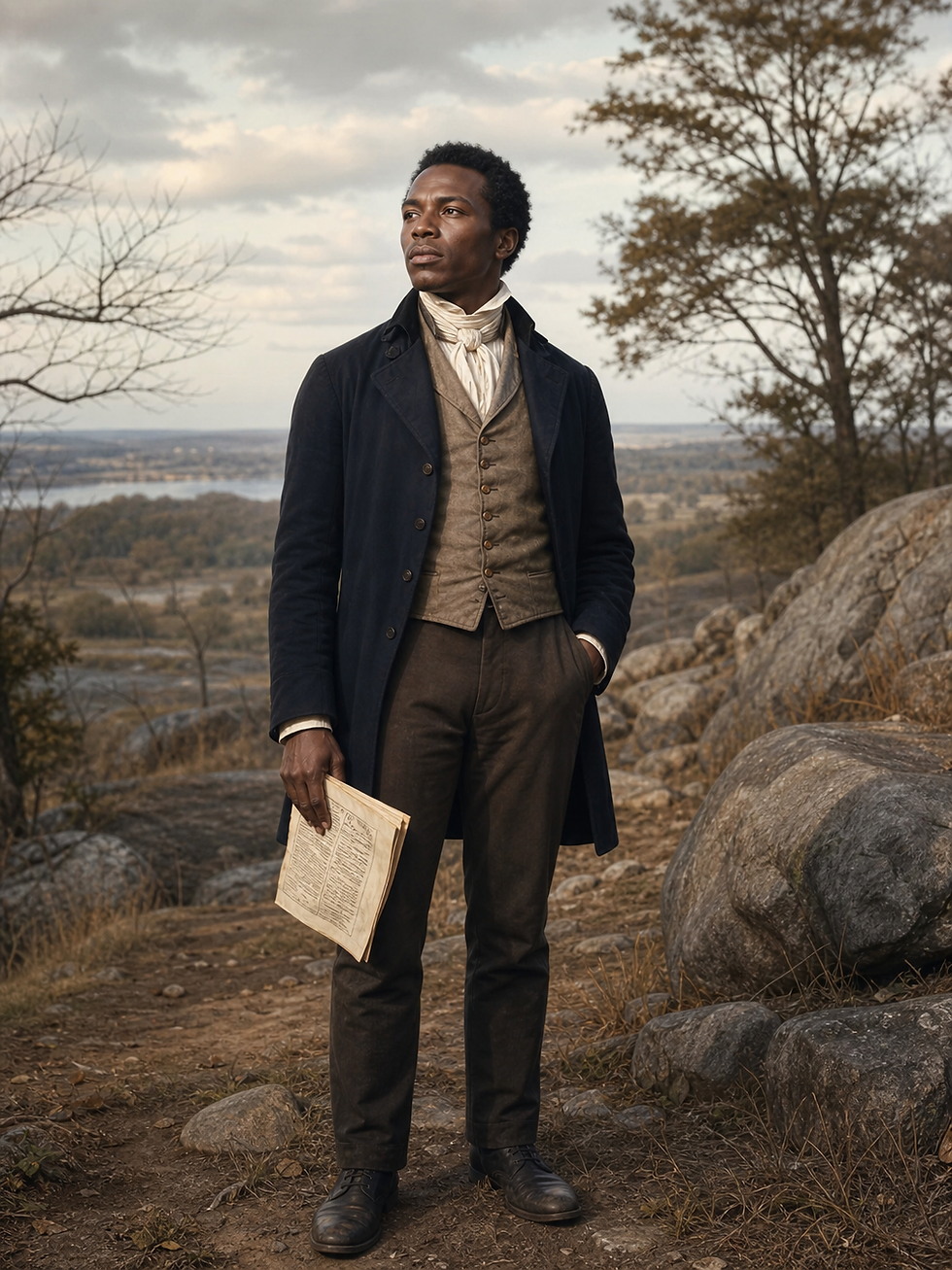
On September 27, 1825, a young Black man named Andrew Williams purchased three lots of land in upper Manhattan. He was about 25 years old. At the time, this part of Manhattan was far from the developed city center. It was rocky, rural, and undeveloped.
But to Williams, that land represented possibility.
That same period, members connected to the African Methodist Episcopal Zion Church also purchased land nearby. Over time, more Black families followed.
The land was not considered prime real estate then. The city’s bustling center was miles to the south. But that distance was part of the promise.
Away from the overcrowding and hostility of lower Manhattan, Black families could build something of their own.
They could own homes.
They could raise children in open air.
They could worship freely.
They could create a community rooted in dignity, faith, education, and self-determination.
And that is exactly what they did.
A Thriving Black Community
Over the next three decades, Seneca Village grew into a stable and established community.

By 1855, it was home to approximately 225 residents. About two-thirds were Black, and about one-third were Irish immigrants. The community also included some German residents, making it one of the early racially and ethnically integrated neighborhoods in New York City.
The Black residents of Seneca Village were not wealthy by Manhattan standards. Many were laborers, domestic workers, tradespeople, and service workers.
But many were homeowners.
They held deeds.
They owned the land beneath their feet.
In a nation that had built wealth through the stolen labor of Black people, and in a city that placed barrier after barrier before Black advancement, these families had done something powerful.
They had acquired property.
They had created permanence.
They had built a village.
Seneca Village was not simply a cluster of houses. It was a community with institutions that anchored daily life.
There were three churches, including the African Methodist Episcopal Zion Church, which had deep ties to Black religious independence and the broader freedom struggle. There was also All Angels’ Church, an Episcopal congregation that served the village.
These churches were more than places of Sunday worship. In 19th-century Black communities, churches were centers of education, organizing, mutual aid, news, protection, and belonging.
Seneca Village also had a school.
In an era when education for Black children was limited and often inferior, the residents made sure their children had access to learning. This was not a small thing. It was a statement.
They were not waiting for the city to value their children.
They valued them first.
The village also had cemeteries—sacred ground where families buried their loved ones. Cemeteries tell us something important about how people understood their place in the world. You do not bury your dead in a place you believe is temporary.
A cemetery is an act of faith in the future.
It says: "We are here. Our people are here. And we intend to remain."

Property, Voting, and Black Political Power
Seneca Village was significant not only because Black families owned property, but because property ownership gave some Black men access to the vote.
Because New York required Black men to own $250 worth of property in order to vote, landownership in Seneca Village mattered politically. It transformed private ownership into civic power.
Some historians have noted that Seneca Village was home to a meaningful share of eligible Black voters in New York City. In a city where the law had been designed to suppress Black suffrage, this small village represented something dangerous to the racial order.
It proved that Black people, when given even a narrow path to land and opportunity, could build stable communities, accumulate property, educate their children, worship collectively, and participate in democracy.
Seneca Village was proof of concept.
And that made it powerful.
It also made it vulnerable.
The Making of Central Park
By the 1850s, wealthy and influential New Yorkers were calling for a grand public park.
New York City was growing rapidly. It was crowded, polluted, and increasingly chaotic. Civic leaders wanted a large green space that would rival the great parks of Europe. They imagined a landscaped refuge where residents could walk, breathe, gather, and experience beauty.
That dream became Central Park.
Today, Central Park is rightly celebrated as one of the great urban parks of the world. But the land chosen for it was not empty.
It was never empty.
It included Seneca Village.
It included homes, churches, a school, cemeteries, gardens, and lives. It included people who had legal claims to the land. The city acquired the land through eminent domain, a legal process that allows the government to take private property for public use, usually with compensation. But for the residents of Seneca Village, the process was devastating.
They were told their property had been condemned.
They were told they had to leave.
They were offered compensation that many believed did not reflect the true value of what they owned. And they fought back.
Residents petitioned. They challenged valuations. They resisted in the ways available to them.
But they were up against the power of the city, the ambitions of elite planners, and a legal system that had rarely protected Black rights when those rights conflicted with white interests.
In 1857, the residents of Seneca Village were displaced. Their homes were demolished. Their churches were destroyed. Their community was erased to make way for Central Park.
The Violence of Erasure
The destruction of Seneca Village was not only physical. It was narrative.
Newspapers of the time often described the area in degrading terms, portraying residents as squatters and their homes as shanties. This language mattered. It helped justify the taking.
By calling residents “squatters,” the press erased the fact that many were legal property owners.
By calling homes “shanties,” they erased decades of labor, investment, and community-building.
This is how dispossession often works.
First, a community is devalued in language.
Then it is devalued in law.
Then it is removed from the land.
Then it is removed from memory.
For more than a century, Seneca Village was largely absent from the popular story of Central Park. The park was often described as if it had been carved from empty wilderness, as if beauty emerged from untouched land rather than from the displacement of real people.
That version of the story was cleaner.
More comfortable.
More flattering.
But it was incomplete.
And incomplete history is not harmless. It teaches people to admire the finished monument without asking who paid the price for it.
What Was Lost
When Seneca Village was destroyed, families lost more than houses.
They lost land.
They lost community.
They lost churches.
They lost access to a school.
They lost sacred burial grounds.
Some lost the property ownership that had made them eligible to vote.
That means the destruction of Seneca Village was not only displacement. It was also disenfranchisement.
A community that represented Black stability and political possibility was dismantled in the name of public improvement.
This pattern is not unique to Seneca Village.
Throughout American history, Black communities that built wealth, ownership, and independence have often faced removal, violence, seizure, or erasure. Sometimes the tool was mob violence. Sometimes it was eminent domain. Sometimes it was redlining, urban renewal, highway construction, or gentrification.
The method changes.
The pattern remains.
Black people build.
Power takes.
History forgets.
And later generations are left to excavate the truth.
Unearthing the Village
In recent decades, historians, archaeologists, educators, and community advocates have worked to restore Seneca Village to public memory.

One of the most significant moments came in 2011, when archaeologists conducted a major excavation in Central Park in the area where Seneca Village once stood. The excavation uncovered hundreds of artifacts, including fragments of pottery, building materials, household objects, and personal items connected to the lives of residents.
These objects matter.
A shard of pottery is not just a shard of pottery.
A foundation stone is not just a stone.
A personal item found beneath the earth is evidence that someone lived, worked, cooked, prayed, learned, loved, and belonged there.
Every artifact is a rebuttal to erasure.
Every recovered object says:
People were here.
Families were here.
A community was here.
Today, Central Park includes signs and educational materials acknowledging Seneca Village. The Central Park Conservancy and other institutions have helped bring more attention to the community’s history. But for many visitors, the park remains simply a park.
The village beneath it remains invisible.
That invisibility is what we must challenge.
Why Seneca Village Still Matters
The story of Seneca Village is not only about loss.
It is also about achievement.
It is about what Black Americans built when given even a narrow margin of freedom.
They bought land.
They built homes.
They established churches.
They educated children.
They buried their dead with dignity.
They exercised political rights in a system designed to deny them.
Every deed they signed was an act of resistance.
Every child they educated was an act of faith.
Every vote they cast was an act of defiance.
Seneca Village lasted just over thirty years. But in those decades, it proved something powerful: Black communities could thrive when they had access to land, stability, and self-determination.
The city took the land.
But it could not take the truth.
The Village Beneath Our Feet
Andrew Williams, the young Black man who purchased those first lots in 1825, could not have known what would happen.
He could not have known that the city would one day destroy the community he helped begin.
He could not have known that more than a century later, archaeologists would dig into the soil and find traces of what had been buried.
He could not have known that his decision to buy land in upper Manhattan would become one of the most significant acts in the history of Black New York.
He bought land because he wanted a home.
He wanted stability.
He wanted something that belonged to him.
And in doing so, he helped create a story that still speaks.
There is a village under Central Park.
There are names in deed books.
There are bones in the ground.
There are children who once walked to school where tourists now stroll.
There are churches beneath the landscape.
There are families whose lives were covered over by lawns, paths, and trees.
We owe them memory.
Not a passing mention.
Not a footnote.
Not a sign people rush past on the way to somewhere else.
We owe them the dignity of being known.
Because when we know what was taken, we understand more clearly what was built.
And when we understand what was built, we understand more deeply who we are.
Seneca Village is gone.
But its story is not.
As long as people continue to teach it, share it, and refuse the comfortable forgetting that history so often prefers, the community that once stood between 82nd and 89th Streets will never truly be erased.
The land was taken.
The homes were destroyed.
The churches were torn down.
But the truth remains—stubborn, sacred, and permanent.
Planted deeper than any tree in Central Park.
Support Independent Storytelling
At Obsidian Guide, published by RTC Publishing Group, LLC, we believe powerful stories deserve to be remembered, preserved, and shared.
If this piece informed, inspired, or moved you, consider making a small donation to support the research, writing, and storytelling behind this work. Every contribution helps us continue creating meaningful historical and cultural content.
Are you the founder of a Black-owned business, product, service, or experience? Submit your brand to Obsidian Guide—a curated destination for discovering exceptional Black-owned businesses and cultural stories.
Visit: www.obsidian-guide.com


Comments