
Andrew Williams: The Young Black Man Who Helped Build Seneca Village

On September 27, 1825, a young Black man named Andrew Williams did something simple, legal, and profoundly radical. He bought land.

At about 25 years old, Williams purchased three lots in upper Manhattan from John and Elizabeth Whitehead for $125. At the time, this part of Manhattan was far from the dense, developed center of New York City. It was rocky, rural, uneven, and largely undeveloped. The city’s commercial life was concentrated miles to the south, and upper Manhattan was still seen by many as remote and undesirable. But to Andrew Williams, that land represented possibility.
It represented freedom with roots. It represented a future.
And with that purchase, Williams helped lay the foundation for what would become Seneca Village, one of the most significant Black communities in 19th-century New York City.
A Purchase That Carried Power
To understand the importance of Andrew Williams’ decision, we have to understand the world he was living in.
New York in the 1820s was a place of contradiction. The state was moving toward the final abolition of slavery, which would take effect in 1827, but freedom did not mean equality. Free Black New Yorkers still faced discrimination in housing, employment, education, politics, and public life. They could work, but often only in the lowest-paying and least secure jobs.
They could live in the city, but often only in overcrowded and neglected neighborhoods.
They could dream of stability, but the systems around them were designed to keep that stability out of reach.
For Black New Yorkers, land ownership was not simply an economic achievement. It was a declaration of personhood.
It said: I belong here. I have a claim. I have a stake in the future.
And in New York, land also carried political meaning.
At the time, Black men were required to own at least $250 worth of property in order to vote. White men did not face the same property requirement. This was a deliberate barrier meant to limit Black political participation while pretending to preserve fairness under the law.
So when Andrew Williams purchased land, he was not only buying property. He was stepping into a form of power that the law had tried to place beyond the reach of Black citizens.
The Land Beyond the City
The lots Williams purchased were located in what is now the west side of Central Park, near the area between present-day West 82nd and West 89th Streets.
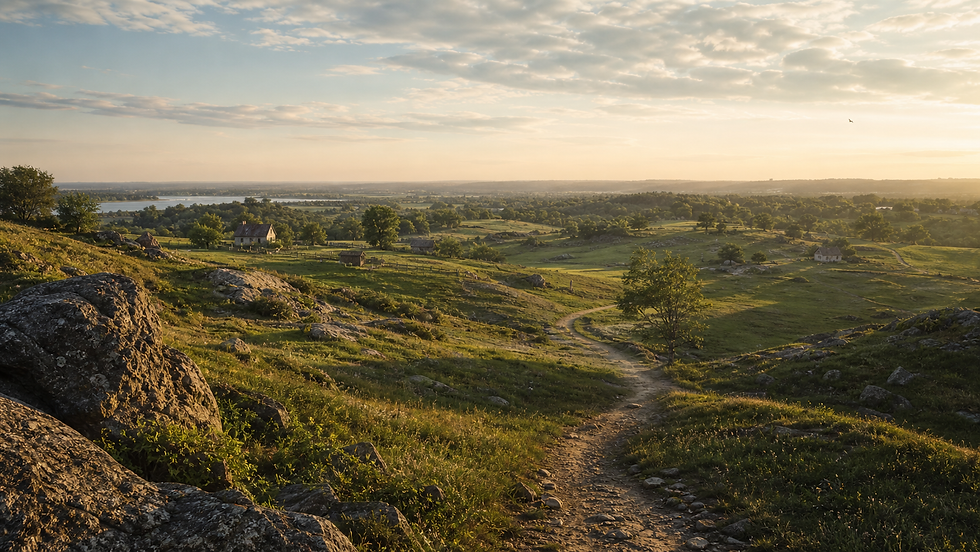
Today, millions of people pass through this part of Manhattan without realizing that families once lived there, worshipped there, educated their children there, buried their loved ones there, and built a community there. But in 1825, this land looked very different.
There were hills, boulders, scattered farms, rough paths, and open space. It was removed from the noise, congestion, and hostility of lower Manhattan. For some, that distance may have made the land less appealing. For Williams, it may have made the land valuable.
There, away from the crowded neighborhoods where many Black New Yorkers were forced to live, families could begin again. They could build homes. They could create institutions. They could raise children with more room, more air, and more dignity.
Andrew Williams’ purchase was one of the earliest steps in that vision.
The Beginning of Seneca Village
Williams was not alone for long.
Soon after his purchase, other Black New Yorkers also acquired land in the area. Epiphany Davis, a store clerk and trustee connected to the African Methodist Episcopal Zion Church, purchased 12 lots. The AME Zion Church also purchased additional lots nearby. From those early transactions, a community began to grow. That community became known as Seneca Village.
Over the next three decades, Seneca Village grew into a stable and established settlement of Black property owners, along with Irish and German immigrant families. By the 1850s, it had become one of the most important communities of free Black landowners in New York City before the Civil War. CBS Sunday Morning describes Seneca Village as home to the largest number of free Black property owners in New York City before the Civil War.
The Black residents of Seneca Village were not wealthy by the standards of New York’s elite. Many were laborers, domestic workers, tradespeople, shoeshiners, cartmen, and service workers.
But many were homeowners.
They held deeds.
They owned the land beneath their feet.
They had something that could be passed down, defended, and claimed.
Seneca Village was not merely a cluster of houses. It was a neighborhood. It had churches, a school, gardens, homes, and cemeteries. It had spiritual life, educational life, family life, and civic life. And all of it began with acts like Andrew Williams’—acts of courage, calculation, and hope.
Why Andrew Williams Matters
Andrew Williams matters because his story reminds us that history is often shaped by people whose names are nearly lost.

He was not a president. Not a famous general. Not a wealthy industrialist. He did not build a monument to himself. He did not leave behind a widely known portrait or a long public record.
But he did something that mattered.
He bought land in a country that had spent centuries denying Black people ownership of themselves, their labor, their families, and their futures.
That act was not small.
For a young Black man in 1825 New York, purchasing land was a statement against every force that said Black people should remain dependent, displaced, and powerless.
Williams’ purchase said something different.
It said:
We can own.
We can build.
We can belong.
We can imagine generations beyond ourselves.
He Knew What His Land Was Worth
The story of Andrew Williams did not end with the purchase of land.
It continued in his refusal to let the city decide, without challenge, what his land and his life’s work were worth.
By the 1850s, New York City had begun moving forward with plans to create a grand public park. That park would become Central Park. The project was praised as a public good, a place of beauty, recreation, and fresh air for a growing city.
But the land selected for the park was not empty.
Seneca Village stood there.
Homes stood there.
Churches stood there.
A school stood there.
Cemeteries stood there.
Families stood there.
In 1853, as Central Park was being planned, the city used eminent domain to take control of the land, displacing the residents of Seneca Village. Andrew Williams resisted.
By then, he had lived on that land for decades. What had once been rocky and undeveloped had become home. It held the labor of his hands, the weight of his years, and the value of a life built with intention.
The city placed a value on his property that Williams believed was too low. According to historical accounts, Williams challenged the valuation and asserted that his home and lots were worth more than what the city initially offered. Some sources note that he was offered $2,335, while he valued the property at $4,000. That difference mattered.
It was not just a disagreement over money. It was a declaration of value.
Williams was saying, in effect: You may have the power to take this land, but you do not have the right to diminish what it means.
For a Black man who had purchased land for $125 in 1825, the home he built represented far more than real estate. It represented decades of work, stability, ownership, and belonging.
When the city tried to reduce that value, he challenged them. His resistance reminds us that Seneca Village was not an empty landscape waiting to become a park. It was not a collection of disposable homes. It was a community of people who understood what they owned, what they had built, and what was being taken from them.
The Weight of What Was Taken
Central Park is beautiful. There is no denying that. But its beauty came at a cost.
The creation of the park required the removal of communities, including Seneca Village. The city acquired the land through eminent domain, and by 1857 the residents were forced out. Homes were demolished. Churches were destroyed. Families were scattered. A community that had taken more than thirty years to build was erased from the landscape. For Andrew Williams, the loss was personal.
He was there at the beginning, when the land was open and full of possibility.
And he was there near the end, when the city decided that his home, his neighbors, and his community stood in the way of progress.
That is part of the tragedy of Seneca Village. It was not destroyed because it failed.
It was destroyed because the land became desirable to people with more power.
More Than a Real Estate Transaction
Andrew Williams’ original purchase was not simply a real estate transaction. It was an act of imagination.
He looked at land that others may have overlooked and saw a future.
He saw permanence where others saw distance.
He saw opportunity where others saw rocks and undeveloped ground. And from that vision, a village grew.
Seneca Village became a place where Black families could own homes, worship, educate their children, bury their loved ones, and participate in civic life. It became proof that Black communities could build stability and dignity when given access to land.
That is why Andrew Williams’ story matters.
He was not just buying property.
He was helping create a foundation for Black self-determination in New York City.
The Truth Beneath the Park
Today, when people walk through Central Park, they are walking over land that once held Black dreams. They are walking over the memory of a village built by people who understood that ownership was more than wealth. It was protection. It was dignity. It was a claim to the future.
Andrew Williams’ three lots were more than land. They were a beginning.
They were the first lines in a story that powerful people tried to erase but could not fully destroy.
Because memory has a way of rising.
In recent decades, historians, archaeologists, educators, and community advocates have worked to bring Seneca Village back into public consciousness. Exhibits, historical markers, archaeological research, and public education have helped restore the names and lives of the people who once lived there.
Andrew Williams’ name now stands as part of that restoration.
He represents the beginning of Seneca Village.
He represents Black land ownership.
He represents resistance.
He represents the refusal to disappear quietly.
A Legacy Planted in the Land
We may never know everything Andrew Williams felt when he purchased those lots on September 27, 1825. We do not know if he imagined a village.
We do not know if he understood how historically significant his decision would become.
We do not know whether he thought his name would still be spoken nearly two centuries later.
But we do know this:
He made a choice that mattered.
He chose ownership in a world that wanted Black people dispossessed.
He chose permanence in a city that treated Black life as temporary.
He chose possibility in a landscape others overlooked.
And from that choice, a community grew.
Andrew Williams reminds us that history is not only made by those who hold official power. Sometimes history begins with a deed, a signature, a few lots of land, and a young person brave enough to believe in a future the world has not yet made room for.
His land was taken.
The village was destroyed. But the meaning of what he did remains.
Andrew Williams bought more than property.
He bought possibility. And from that possibility, Seneca Village was born.
Watch More
To learn more about Seneca Village and the efforts to restore its story to public memory, watch the CBS Sunday Morning feature on the historic settlement that disappeared.
Watch here:https://youtu.be/TBxVLdQgGgs
Support the Stories That Matter
At Obsidian Guide, published by RTC Publishing Group, LLC, we believe powerful stories deserve to be remembered, preserved, and shared.
If this piece informed, inspired, or moved you, consider making a small donation to support the research, writing, and storytelling behind this work. Every contribution helps us continue creating meaningful historical and cultural content.
Have a Black-owned business, product, service, or experience? Submit it to Obsidian Guide, a curated platform created to celebrate exceptional Black-owned brands and cultural stories.

Comments