
Marian Robinson: The Quiet Matriarch Who Held the Room Together

Some legacies do not announce themselves.
They do not arrive with speeches, cameras, or carefully polished statements. They move quietly, steadily, through kitchens, school mornings, dinner tables, family decisions, and the private moments history later realizes were sacred. Marian Lois Shields Robinson was that kind of woman.

To the world, she was Michelle Obama’s mother, Barack Obama’s mother-in-law, and the grandmother who moved into the White House to help raise Sasha and Malia during one of the most consequential presidencies in American history. But to her family, she was something deeper: the steady center, the truth-teller, the refuge, the woman who did not need the spotlight to shape the story. Her life was not built around power. It was built around presence.
A Daughter of Chicago’s South Side
Marian Robinson was born Marian Lois Shields in Chicago on July 30, 1937. She grew up on the South Side of Chicago, one of seven children, in a family shaped by work, discipline, and the quiet expectations of everyday resilience. She later married Fraser Robinson III, and together they raised two children: Craig Robinson and Michelle Robinson Obama.
The Robinson home was not grand in size, but it was rich in formation. In the upstairs apartment on South Euclid Avenue, Marian and Fraser created a family culture where children were expected to think, speak, question, and carry themselves with dignity. The source text notes that Marian taught both Craig and Michelle to read before they started school and helped create a home where their voices had weight. That detail matters.
Before Michelle Obama became First Lady, before Barack Obama became the first Black president of the United States, before history attached itself to the family name, there was a mother sitting beside her children, sounding out words on a page. There was Marian.
The Strength Behind the Strength
Marian’s marriage to Fraser Robinson III became one of the defining anchors of her life. Fraser, remembered by the family as a man of strength and cool, was diagnosed with multiple sclerosis in early adulthood. The disease slowly affected his mobility, but he continued working and showing up for his family.
Marian watched that endurance up close. She became a wife, mother, caregiver, witness, and stabilizing force. When Fraser died in 1991, Marian was only fifty-three years old. She would live more than three decades without him, carrying forward the values they had built together.
There is a particular kind of grace in women who survive loss without becoming hardened by it. Marian Robinson did not become performative. She became even more herself: plainspoken, practical, loyal, discerning, and deeply rooted. She was not easily impressed by ambition. She believed in character.
That is why her early reaction to Barack Obama is so memorable. According to the source text, when Michelle and Barack were dating, Marian sized him up with the kind of unsentimental clarity only a mother can deliver. She reportedly gave the relationship six months.
She was off by more than three decades.
But even that misjudgment says something revealing. Marian did not rush to romanticize anyone. Not even the man who would one day become president.
Election Night and the Hand That Reached
One of the most moving images from the 2008 election night is not the crowd in Grant Park, not the soaring speech, not the national celebration.

It is the photograph of Barack Obama and Marian Robinson sitting together on a couch at the Hyatt Regency Chicago, watching the election returns.
They are holding hands.
The story around that image has often been retold with a viral quote suggesting Marian explained the gesture by listing Barack Obama’s losses: his father, his mother, his grandmother. But the source text carefully notes that this quote does not appear to be verified in a public interview, book, or statement. The real story is quieter. According to the supplied account, Michelle Obama wrote in Becoming that Barack asked Marian, “Are you ready for this, Grandma?” and Marian responded with a sideways look and a shrug. Later, when Michelle got up from the couch, Marian reached across and took Barack’s hand. That is the Marian Robinson story in miniature.
No speech.
No performance.
Just recognition.
Barack Obama’s father had died years earlier. His mother, Ann Dunham, had died in 1995. His grandmother Madelyn Dunham, who helped raise him, died just two days before the 2008 election. On the night he became president-elect, one of the only parental figures left in the room was Marian Robinson.
America saw a president.
Marian saw a man stepping into history with no parents beside him.
So she reached.

The Grandmother in the White House
After the election, Marian Robinson moved to Washington, D.C., to help care for her granddaughters, Sasha and Malia. She was known for maintaining a low profile, helping preserve a sense of normalcy for the girls during their father’s presidency.
She lived in the White House, but she never seemed consumed by it. Reports after her death described her as a steady presence who preferred privacy, family, and ordinary routines over public attention. That may be one of the most remarkable parts of her story.
Marian Robinson lived inside one of the most powerful addresses in the world and still managed to remain herself. She did not become a symbol because she chased symbolism. She became one because she resisted spectacle.
She represented something many families recognize immediately: the grandmother who keeps children grounded, the mother who speaks plainly, the elder who does not need applause because she knows exactly who she is.
A Life That Returned Home
When the Obama presidency ended, Marian Robinson returned to Chicago. That, too, feels fitting. She had lived through history, but her roots remained where they had always been: family, home, neighborhood, memory, and the South Side city that shaped her.
Marian Robinson died on May 31, 2024, at the age of 86. Her family remembered her as a woman whose wisdom often came in a word or two, whose presence steadied everyone around her, and whose example would continue guiding them.
Michelle Obama later honored her mother publicly, reflecting on the love and support the family received after Marian’s passing and emphasizing the way her mother made people feel enough.
That may be the heart of Marian Robinson’s legacy. She made people feel enough.
Not by flattering them. Not by overexplaining. Not by pretending life was easier than it was.
But by showing up.
The Love That Does Not Announce Itself
Marian Robinson’s life reminds us that history is not only shaped by those who stand at podiums. It is also shaped by those who prepare the people who stand there.
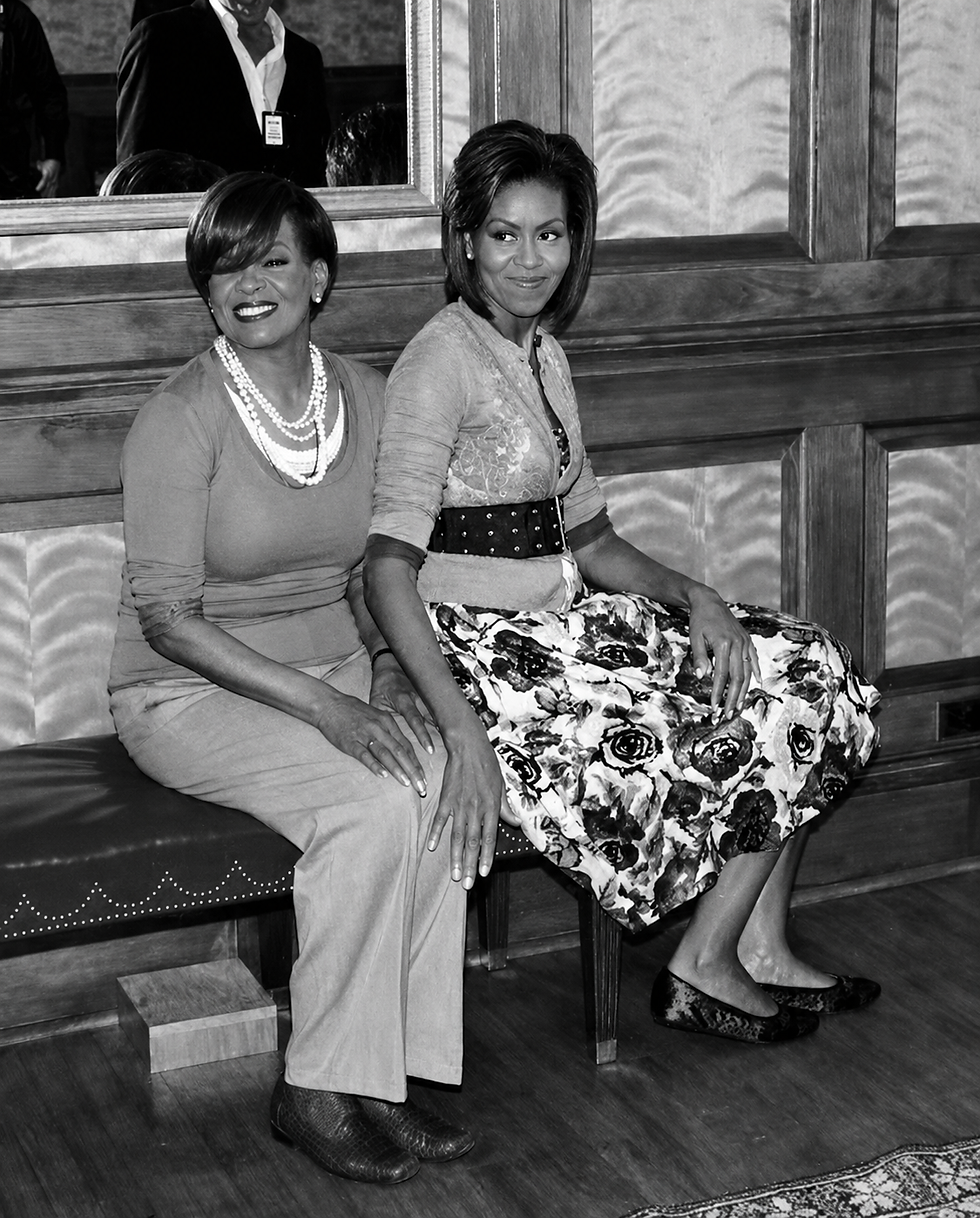
She raised a daughter who would become First Lady of the United States. She helped ground granddaughters growing up under global attention. She offered quiet comfort to a son-in-law on the night he stepped into a burden few people could imagine. She did not need the microphone. She held the room in other ways. Her power was not ornamental. It was foundational.
Marian Robinson’s story is the story of the Black matriarch whose work is often invisible until the world finally understands what she held together. It is the story of women who teach children to read, defend them when they are wronged, speak truth without decoration, and love without theatrics.
On one of the biggest nights in American history, Marian Robinson did not make a speech.
She looked sideways.
She shrugged.
Then she reached across the couch and held a hand.
And sometimes, that is the whole legacy.
A love that does not announce itself.
It simply shows up.
If this story inspired you, consider supporting more stories that celebrate Black excellence, legacy, culture, and community impact.
Donate Here provided through RTC Publishing Group, LLC.


Comments